
Cat 6 vs Cat 6A: Which One Should You Pull?
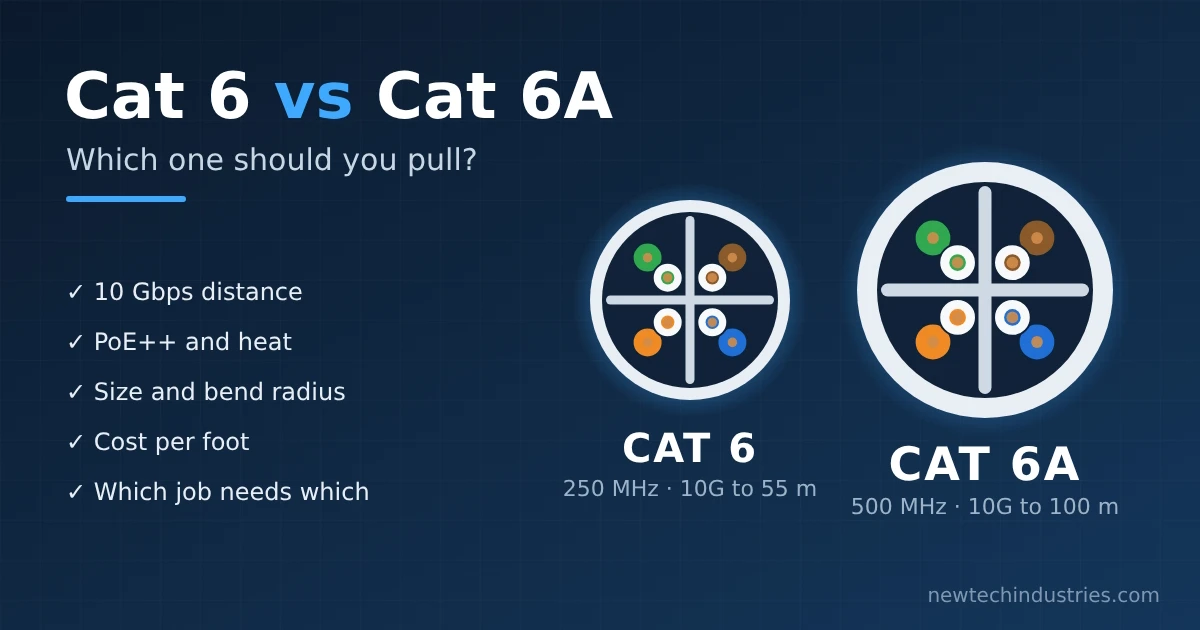
Intro
A while back we settled the great Cat 5e vs Cat 6 debate (spoiler: Cat 6 won, and nobody had to sleep on the sofa). Naturally, the next question landed on our counter about five minutes later: "So what about Cat 6A? Is that 'A' worth paying for, or is it just there to make the box look important?"
Fair question. The letter is only one character long, but it changes a surprising amount, from how fast your network can go to how much swearing happens when you try to fit it through a conduit. Let's sort it out in plain English.
The short answer
If you only read one paragraph, make it this one. Cat 6 is plenty for most homes and small offices running 1 gigabit. Cat 6A is the one to pull if you want 10 gigabit over a full 100-metre run, you're powering Wi-Fi 6E or Wi-Fi 7 access points, or you're feeding high-power PoE devices. And if the walls are open and you plan to stay in the building a while, Cat 6A is cheap insurance against pulling cable twice.
Cat 6 vs Cat 6A side by side
|
Bandwidth |
250 MHz |
500 MHz |
|
1 Gbps distance |
100 m (328 ft) |
100 m (328 ft) |
|
10 Gbps distance |
About 37 to 55 m (121 to 180 ft), depending on interference |
Full 100 m (328 ft) |
|
Typical outside diameter (UTP) |
About 0.22 to 0.25 in |
About 0.27 to 0.30 in |
|
Alien crosstalk protection |
Not specified |
Built into the standard |
|
High-power PoE (60 to 90 W) |
Works, but runs warmer in big bundles |
Handles heat better, especially in bundles |
|
Price |
The budget pick |
Typically 30 to 50% more per foot |
|
Best for |
1 Gbps homes and offices, cameras, phones |
10 Gbps, Wi-Fi 6E/7 access points, PoE++, future-proofing |
What the "A" actually buys you
The A stands for "Augmented", which is a very grand way of saying "we fixed the bits that struggled at 10 gig". Three things change.
10 gigabit all the way to 100 metres. Cat 6 can run 10 Gbps, but only for roughly 37 to 55 metres before it starts to wobble. Cat 6A doubles the bandwidth to 500 MHz and carries 10 Gbps over the full 100-metre channel. If your runs are long, that's the whole ball game.
Protection from alien crosstalk. No, not little green men in your ceiling. Alien crosstalk is noise that leaks between neighbouring cables in a tight bundle. At 10 gig it becomes a real problem, so Cat 6A cables are built to resist it, using tighter twists, a thicker jacket, internal separators or shielding.
Better behaviour with high-power PoE. Today's PoE++ devices can pull up to 90 watts down the cable (see our [POE++ 90 Watts post] if you want the nerdy detail). More power means more heat, and heat in a big bundle hurts performance. Cat 6A's larger construction sheds heat better, so it keeps its cool when you're powering a ceiling full of access points or PTZ cameras.
The catch (there's always a catch)
Cat 6A isn't perfect. Before you order a pallet of it, know what you're signing up for.
- It's chunky. Cat 6A is noticeably thicker and stiffer. You'll fit fewer cables in a conduit, a J-hook or a tray, so plan your pathways accordingly.
- It needs room to bend. Keep the bend radius to at least four times the cable's diameter. Tight corners behind a wall plate can hurt performance.
- It costs more. Expect to pay roughly 30 to 50% more per foot, plus a bit more for Cat 6A-rated jacks and patch panels.
- It takes longer to terminate. Thicker conductors and separators mean a little more prep time per end. Not hard, just slower. A good pair of strippers and a punch-down tool help a lot here.
Which one for which job
|
The job |
Our pick |
Why |
|---|---|---|
|
Home network, streaming, gaming |
Cat 6 |
1 Gbps internet doesn't need more, and Cat 6 is easier to pull |
|
Small office, desk drops, VoIP phones |
Cat 6 |
Gigabit to the desk is still the norm |
|
Wi-Fi 6E or Wi-Fi 7 access points |
Cat 6A |
Newer APs use 2.5, 5 or 10 Gbps uplinks and PoE++ |
|
Security cameras |
Cat 6 (Cat 6A for PTZ or heated cameras) |
Most cameras sip power; the hungry ones like Cat 6A |
|
Server room, switch-to-switch links |
Cat 6A (or fiber) |
10 Gbps over full distance |
|
New build or full renovation |
Cat 6A |
You only get to open the walls once |
Rule of thumb: if you're unsure and the walls are open, go Cat 6A. If you're adding a single drop to an existing Cat 6 network, stick with Cat 6.
Don't forget the jacket, or the rest of the run
A cable is only as good as its weakest link. Two things trip people up.
Pick the right jacket for the space. Cable running through an air-handling space (like a drop ceiling used for return air) needs a plenum (CMP) jacket. Cable running vertically between floors needs at least riser (CMR). Outdoors or underground, go with an outdoor-rated, direct-burial cable. The fire inspector will not accept "but it was on sale".
Match every component. Cat 6A cable plugged into Cat 6 jacks and Cat 5e patch cords gives you... a Cat 5e network with an expensive middle. Your jacks, patch panels, keystones and patch cords all need the same rating as the cable to get the performance you paid for.
Frequently asked questions
Is Cat 6A worth it for a home? Usually not, unless you have multi-gig internet, a home server or Wi-Fi 7 access points. For a typical 1 Gbps home connection, Cat 6 does the job.
Can I use Cat 6A with my existing Cat 6 equipment? Yes. Cat 6A is fully backwards compatible and uses the same RJ45 connectors. You just won't get 10 Gbps unless everything in the run supports it.
Can Cat 6 do 10 gigabit? Yes, but only over shorter runs, roughly 37 to 55 metres (121 to 180 feet). Beyond that, you need Cat 6A.
Is Cat 6A shielded? It comes both ways. Unshielded (UTP) Cat 6A is common and easier to install. Shielded (F/UTP) versions are thinner and offer extra noise protection, but they must be properly grounded.
What about Cat 8? Cat 8 is built for 25 to 40 Gbps over very short runs (up to 30 metres), mainly inside data centres. For building cabling, Cat 6A is the sweet spot.
Ready to pull some cable?
Whether you've landed on Cat 6 or Cat 6A, New Tech Industries has you covered, from bulk boxes in plenum, riser and outdoor jackets to matching jacks, patch panels and patch cords. We've been supplying South Florida's installers and contractors since 1982, so if you're still not sure which one your job needs, give us a call. We're happy to talk cable. Honestly, we'd probably talk cable even if you didn't ask.